
“Is the mountain high?”
That’s what The Fool wanted to know when I walked the Medicine Wheel a few weeks before my first trip to Scotland.
Let me step back 10 years and tell you about The Fool, the Medicine Wheel and a mountain called Dun I (pronounced done-EE).
At a little more than 400 feet above sea level, Dun I is the highest point on the island of Iona. Many, many years ago, in prehistoric times, Dun I was a fort. Today, it is a place where visitors find solitude and expansive views of Iona, the Atlantic Ocean, the Isle of Mull and other neighboring islands.
Iona was one of several sites I visited when I went to Scotland with five other women in September of 2000. Anna, Lainie, Delpha, Aprille, Robin and I mapped out a pilgrimage that had been inspired by Jean Shinoda Bolen’s book, Crossing to Avalon.
The Medicine Wheel Riddle
Before we left Maryland for Glasgow, Robin led us through a process called the Medicine Wheel, a decision making tool used by Native American people. The "wheel" consists of individuals who stand in a circle posing as the archetypes Tradition, the Warrior, the Shaman, the Witch, the Tribal Chief, the Creator, and the Pattern-keeper. Before walking the circle, the person seeking guidance whispers a question into the ear of the Fool, the eighth member of the Medicine Wheel. The Fool flips the question into a seemingly unrelated query. The seeker takes the transformed question to each character. One by one, the ancient wisdom keepers respond in the spirit of their character.
When it was my turn to walk the Medicine Wheel, I whispered to The Fool, “Am I destined to use my creativity as a writer?” Without hesitation, The Fool whispered back, “Is the mountain high?”
Traveling around the Wheel, I asked The Fool’s question. Tradition began a series of disturbing answers by saying, “The sky is blue.” The Warrior told me, “Mountains have been high for centuries.” Next, the Shaman said, “It’s as high as you can see.” The Witch pronounced a curt, “Some are, some aren’t.” Leading me down a different path, the Tribal Chief said, “The people are strong.” Returning to talk of the mountain, the Creator added, “It’s only as high as you think it is.” The last elder to speak, the Pattern Keeper, offered a nonchalant, “Mountains are what mountains are.”
I left the Medicine Wheel experience frustrated. What did mountains and this other nonsense have to do with how I would spend the next half of my life? I could only hope that the riddle would be solved as I trekked the highlands and the lowlands of Scotland.
A Hiking Lesson
During our two days on Iona, we agreed to spend one day on our own. After practicing yoga on a hilltop overlooking the Abbey, I took a hike. I headed toward a mountain I had seen in the distance. I will make it that far and that high, I said to myself whenever a barbed wire fence blocked my way or a gust of cold ocean wind tempted me to go back to the inn for a cup of tea.
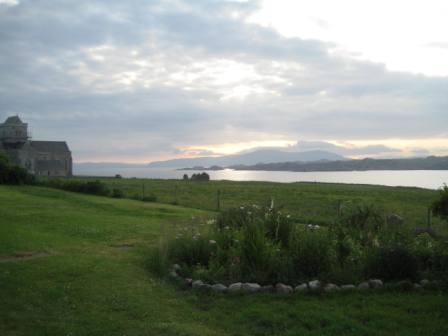
View of the Iona Abbey from Dun I

After hours of hiking across pastures alone except for the occasional herd of sheep, I arrived at the top of Dun I. I was a mess. My shoes were caked with sheep droppings, my socks were soaked and my pants were splattered with mud. I sat at the top of the mountain, watching the sea brush the shores of the island. As I rose to leave, I saw Robin. She stood on a rock several yards below me. Her face glowed as she looked out across Iona.
A seasoned outdoorswoman, Robin had scaled much higher peaks on several continents. Yet, this was one mountain she hadn’t expected to climb. For several years before this trip, Robin had been in treatment for breast cancer. A few months before we were scheduled to leave for Scotland, she was unsure that she would be well enough to go with us.
Climbing this mountain was a major accomplishment for both of us. My triumph was simple and profound: I had allowed myself to get dirty, to wander alone, to be clumsy and to risk getting lost. Robin stood in wonder at the physical stamina she had mustered to reach the highest point on the island. Standing on this rise out in the sea, we both remembered the miracle of being alive.
Robin told me she was was deciding which route to follow back to the village. She pointed to two paths—one to our left that looked like a straight, clear route down to the main island road, and another more circuitous and rocky way to our right. After examining both of them, she chose the right-hand path.
“Sometimes the easier path is actually the more dangerous one,” she said. I listened as she explained that, even though the straight path looked easier, one misstep could lead to a hazardous fall down its steep, unprotected slope. The other, more crooked path might be slower and require more work, but it had a grassy shoulder to cushion a stumble.
As I absorbed Robin’s hiking wisdom, I remembered my Medicine Wheel question. I realized that Robin had given me my answer. I had psyched myself into believing that being a writer was a dangerous path littered with solitude, criticism and rejection. Relinquishing my writing dream and going back to a safer, more established job might have seemed easier. I also knew that working in fast-paced corporate settings where the income was lucrative and the work secure had endangered my health, sapped my energy and depleted my creative juices. I saw, too, that her guidance applied not only to my work, but also to my relationships and my spiritual path.
In the years since I climbed down Dun I with Robin, I have applied her hiking advice to the challenges of daily living. When I am tempted to run away, hide out or relinquish a dream, I remember that the easy route can be the more dangerous one.
Soon after returning from Scotland, I stepped up and declared that I am a writer; I admitted that being a communicator is my life’s work. I continually exercise my creative muscles whether I am working on a feature story on a health topic, writing a news release for a community event or scribbling a poem in my journal.
More Lessons from Dun I

Back on Iona in 2010, I headed for Dun I on my first free afternoon. This time, I entered the path to the mountain through a gate off of the main island road.
At the top of Dun I, I found a spot on a flat rock and sat quietly, dazzled by the turquoise waters that held the island on all sides. The wind moved in cold gusts as the cloud-covered sun burned a hole in the thick morning fog.
After taking a rest, I walked around the top of the mountain. I searched for the spot where Robin had given me a hiking lesson 10 years earlier. The terrain looked different. Every way down looked steep and dangerous.
I decided I would go down the way I came up. I remembered that, on the way up, I had used sheer muscle and the exertion of my pounding heart to move from the flat pasture of the farmer’s sheep fields to the rocky surface of the hilltop. Going down, I stepped more carefully. This was an exercise in agility and attention tempered with a dose of humility when I sat on my butt to scramble down a few rocky patches.
In the years since my first climb to Dun I, I have become more comfortable walking along what looks like the more dangerous path. I look for challenges and willingly go into situations that are new and unknown. On my second climb up Dun I, the mountain had a different lesson to teach. I noticed that climbing to reach higher planes where I can find broader views of the landscape is heart work. It takes compassion and courage - and a good bit of willpower - to take myself up and away from the day to day of life, where I can get a new point of view. Coming back down to earth – back into the worlds of work, relationships and the quotidian of paying the bills, doing the dishes and weeding the garden - requires clear thinking, some forward planning and the willingness to look clumsy and to stumble a bit.
I live life as if it were a mountain climb even though I live on Maryland’s Eastern Shore, one of the flattest terrains on Earth. Heart and strength, patience and humility are worthy companions no matter how challenging the task. And when the path looks easy, I step back and wonder, “Is this mountain high enough?”

Climbers add stones to the cairn at the top of Dun I


